

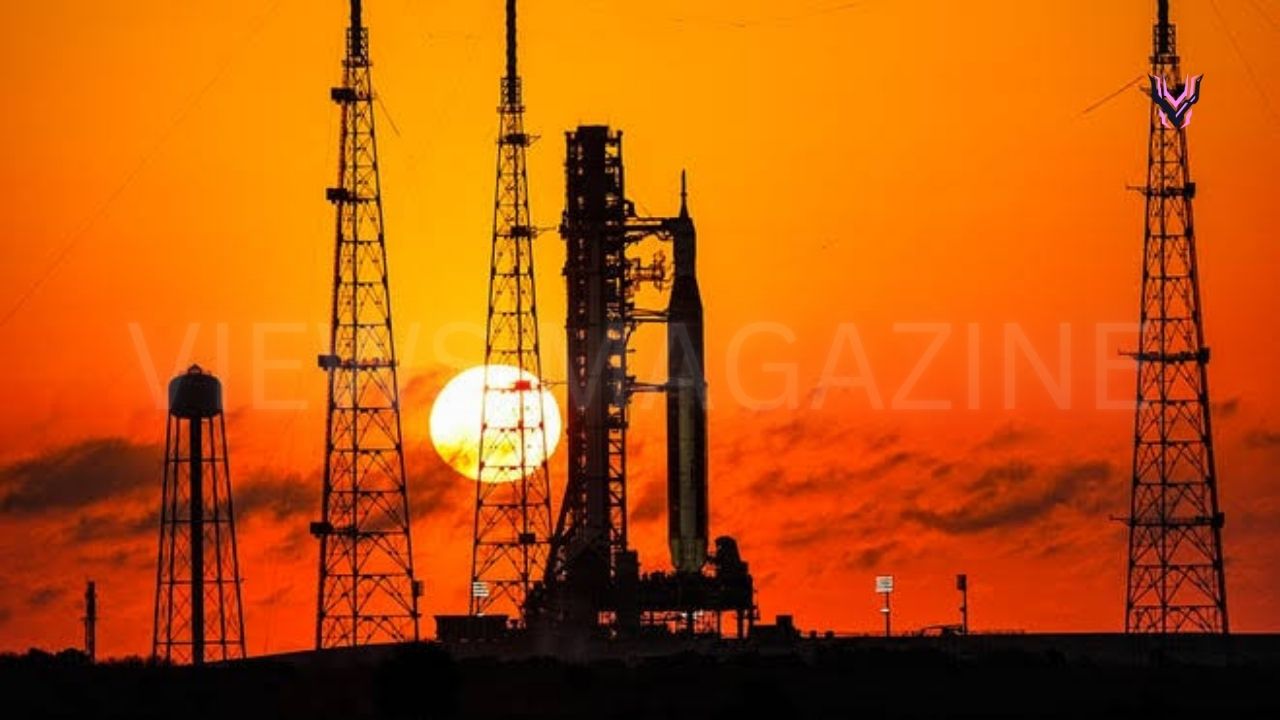
NASA has announced an important update for the NASA SunRISE Mission, confirming that the six-spacecraft solar research project will now launch aboard a SpaceX Falcon Heavy rocket. The mission was previously scheduled to fly on United Launch Alliance’s (ULA) Vulcan Centaur, but NASA has revised its launch plan while keeping the mission’s scientific objectives unchanged. The announcement marks a significant milestone for one of NASA’s most innovative heliophysics projects.
The agency shared the update on July 13, 2026, stating that the mission will launch from NASA’s Kennedy Space Center in Florida as part of a rideshare mission sponsored by the U.S. Space Force’s Space Systems Command. NASA has not yet announced a specific launch date, saying more scheduling details will be released in the future.
NASA Announces a New Launch Vehicle
The NASA SunRISE Mission was originally assigned to launch aboard the ULA Vulcan Centaur rocket. However, NASA has officially confirmed that the mission will instead fly on SpaceX Falcon Heavy, one of the world’s most powerful operational launch vehicles.
Although the agency did not provide a detailed explanation for the change, it emphasized that only the launch vehicle has changed. The spacecraft, mission design, scientific goals, and planned observations remain the same. NASA also confirmed that the revised launch arrangement supports the mission’s overall schedule and long-term research objectives.
Why SpaceX Falcon Heavy Was Selected
The SpaceX Falcon Heavy is capable of carrying heavy payloads into a wide range of Earth and deep-space orbits. Its high payload capacity and proven launch record make it well suited for complex scientific missions that require precise orbital placement.
For the NASA SunRISE Mission, Falcon Heavy will deploy six SmallSats into their planned orbit, allowing them to begin operating together as a single scientific instrument. The launch will take place through a rideshare opportunity coordinated with the U.S. Space Force, maximizing efficiency while reducing overall mission costs.
What Is the NASA SunRISE Mission?
The Sun Radio Interferometer Space Experiment (SunRISE) is a NASA heliophysics mission designed to study radio emissions produced by the Sun. Instead of using one large spacecraft, the mission relies on six toaster-sized SmallSats flying in carefully controlled formation.
Working together, these satellites will function like one giant radio telescope in space. This unique design enables scientists to capture low-frequency radio signals that cannot be observed effectively from Earth’s surface because the planet’s atmosphere blocks many of those frequencies.
Mission Goals and Scientific Importance
The primary goal of the NASA SunRISE Mission is to investigate powerful radio bursts generated in the Sun’s outer atmosphere, known as the corona. These radio bursts are closely linked to solar eruptions that release energetic particles into space.
Scientists hope the mission will reveal where these bursts originate and how they travel through space. A better understanding of these events could significantly improve space weather forecasting, helping researchers predict solar storms before they affect satellites, astronauts, GPS navigation systems, radio communications, and electrical power infrastructure on Earth.
The mission will also demonstrate advanced formation-flying technology. Maintaining precise distances between six independent spacecraft is an engineering challenge, and success could support future space missions that rely on multiple satellites working together.
Spacecraft Already Ready for Launch
NASA confirmed that all six SunRISE SmallSats have completed assembly and environmental testing at Utah State University’s Space Dynamics Laboratory in Logan, Utah. The spacecraft are currently in storage while the agency finalizes launch preparations.
Mission operations will be managed by NASA’s Jet Propulsion Laboratory (JPL) in Southern California. The scientific investigation is led by the University of Michigan, with contributions from several research institutions and NASA partners.
What Happens Next?
NASA will announce the official launch schedule after coordinating with SpaceX and the U.S. Space Force. Once in orbit, the six satellites will separate from the launch vehicle and gradually position themselves into their planned formation before beginning scientific observations.
Researchers expect the mission to collect valuable data on solar radio emissions that will complement observations from other NASA solar missions, including the Parker Solar Probe and the Solar Dynamics Observatory.
Conclusion
The decision to launch the NASA SunRISE Mission aboard SpaceX Falcon Heavy represents an important logistical update rather than a change in scientific direction. The mission’s goal remains the same: to unlock new insights into the Sun’s radio activity and improve scientists’ ability to forecast hazardous space weather. With its innovative six-satellite design and advanced observational capabilities, SunRISE is expected to play a key role in expanding humanity’s understanding of our closest star.
Source: NASA Science – SunRISE Mission Update (July 13, 2026), NASA Jet Propulsion Laboratory, and NASA Heliophysics Program. Stay More Update VIEWS MAGAZINE