
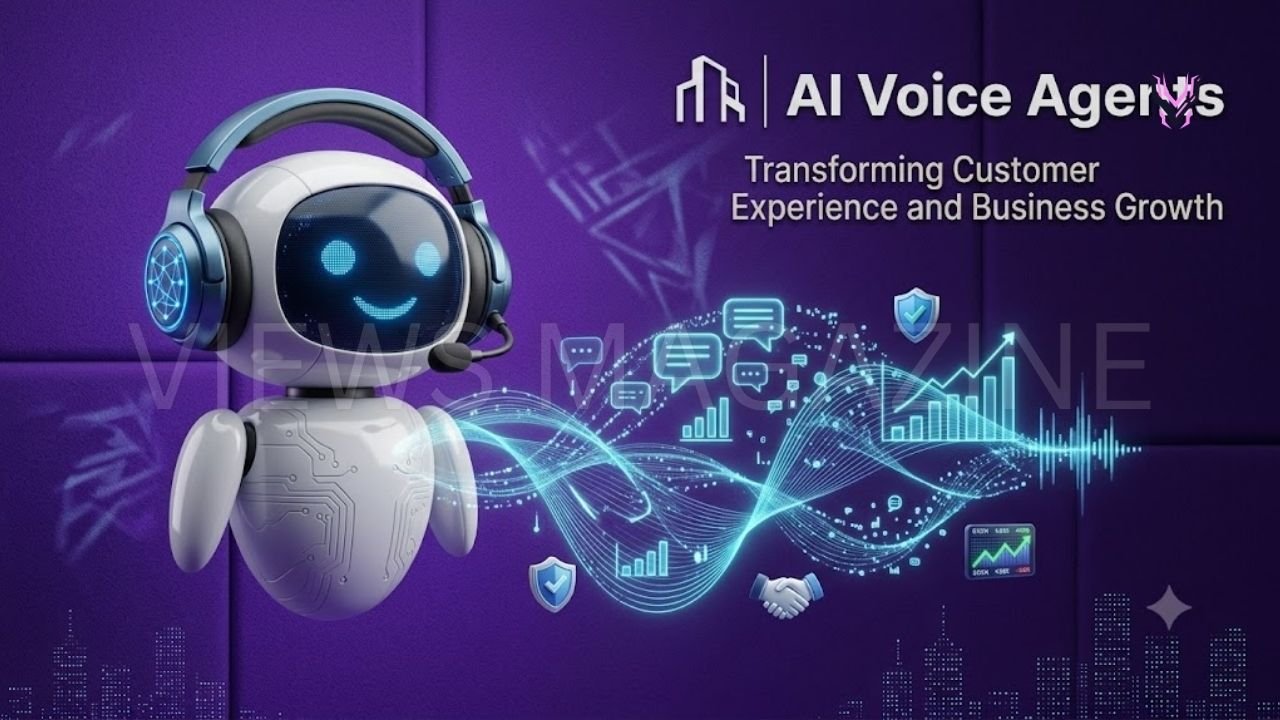
Artificial intelligence has transformed the way businesses communicate with customers, and one of the biggest innovations is the AI Voice Agent. Unlike traditional automated phone systems that rely on fixed menus and scripted responses, an AI Voice Agent can understand natural speech, respond intelligently, and handle real conversations. Businesses across healthcare, banking, retail, real estate, and customer service now use AI Voice Agents to improve response times, reduce costs, and deliver better customer experiences.
The demand for AI Voice Agents continues to grow because they operate around the clock and manage thousands of conversations simultaneously. Modern voice agents use advanced technologies such as Automatic Speech Recognition (ASR), Natural Language Processing (NLP), Large Language Models (LLMs), and Text-to-Speech (TTS) to communicate naturally with callers. This guide explains how AI Voice Agents work, their key features, and the business benefits they provide in today’s competitive market.
What Is an AI Voice Agent?
An AI Voice Agent is an intelligent software system that communicates with people through natural voice conversations. Instead of following simple prerecorded prompts, it listens to spoken language, understands the user’s intent, processes the request, and provides relevant answers in real time. Many businesses use AI Voice Agents to answer customer questions, schedule appointments, process orders, qualify leads, and provide technical support without requiring a human representative for every interaction.
Unlike traditional Interactive Voice Response (IVR) systems, AI Voice Agents can maintain contextual conversations and adapt to different customer requests. They understand follow-up questions, recognize conversational patterns, and provide personalized responses. As generative AI technology continues to improve, AI Voice Agents are becoming more accurate, more natural, and more capable of handling complex customer interactions across multiple industries.
How an AI Voice Agent Works
An AI Voice Agent combines several artificial intelligence technologies to create a smooth conversational experience. The process begins when a customer speaks into a phone or connected device. Automatic Speech Recognition converts the spoken words into text, allowing the system to analyze the conversation. Natural Language Processing then identifies the customer’s intent, while a Large Language Model generates an appropriate response based on the context of the discussion.
After generating a response, the system converts text back into realistic speech using Text-to-Speech technology. The AI Voice Agent can also retrieve information from connected databases, CRM systems, calendars, or business software before replying. This seamless workflow enables businesses to automate customer interactions while maintaining fast response times, consistent service quality, and accurate information throughout every conversation.
Key Features of AI Voice Agents
Modern AI Voice Agents include a wide range of features that improve communication and business efficiency. They support natural conversations, understand multiple languages, recognize different accents, and provide responses with human-like voices. Many platforms also include sentiment analysis, call recording, real-time analytics, and integration with business applications such as customer relationship management systems and scheduling software.
Another important feature is continuous learning. AI Voice Agents improve over time by analyzing conversations and adapting to user behavior. They can transfer complex cases to human agents when necessary while maintaining the conversation history. Advanced reporting dashboards allow businesses to monitor call performance, customer satisfaction, response accuracy, and operational efficiency, helping organizations continuously improve customer service.
Benefits of Using AI Voice Agents
AI Voice Agents provide significant advantages for organizations seeking to improve customer service while reducing operational costs. They remain available twenty-four hours a day without requiring breaks, allowing customers to receive immediate assistance regardless of the time. This constant availability improves customer satisfaction, reduces wait times, and enables businesses to support global audiences across different time zones.
Businesses also benefit from increased productivity because AI Voice Agents handle repetitive tasks automatically. They answer frequently asked questions, schedule appointments, process simple requests, and collect customer information before transferring complex cases to human representatives. By automating routine conversations, organizations allow employees to focus on higher-value work, improve service quality, and reduce overall customer support expenses.
AI Voice Agent Use Cases Across Industries
AI Voice Agents have become valuable tools across many industries because they automate customer interactions while maintaining fast response times. Healthcare providers use them to schedule appointments, send medication reminders, and answer patient inquiries. Banks rely on AI Voice Agents for account verification, balance inquiries, and fraud alerts. Retailers use them to track orders, process returns, and provide product information, improving customer satisfaction without increasing staffing costs.
Other industries have also embraced AI Voice Agents to improve operational efficiency. Real estate agencies qualify leads and schedule property viewings through automated voice conversations. Hotels manage reservations and guest requests using voice assistants. Educational institutions answer admission questions and notify students about important updates. Telecommunications companies use AI Voice Agents to troubleshoot common technical issues, reducing call center workloads and delivering quicker support.
AI Voice Agent vs Traditional Call Centers
Traditional call centers depend heavily on human agents to answer customer questions, which often leads to long waiting times during busy hours. AI Voice Agents solve this challenge by handling thousands of calls simultaneously without sacrificing response speed. They deliver consistent answers, work around the clock, and reduce operational costs by automating repetitive customer interactions that previously required human assistance.
Human agents still play an essential role in handling sensitive or highly complex conversations. However, AI Voice Agents significantly reduce their workload by resolving routine requests before escalation becomes necessary. This collaboration creates a hybrid customer service model where automation improves efficiency while human employees focus on solving difficult cases that require empathy, judgment, and personalized decision-making.
AI Voice Agent vs AI Chatbots
Although both technologies use artificial intelligence, AI Voice Agents and AI chatbots serve customers through different communication channels. AI chatbots primarily interact through text on websites, mobile applications, and messaging platforms. AI Voice Agents communicate through spoken conversations, allowing customers to speak naturally over phone calls or voice-enabled devices without typing messages or navigating complicated menus.
Voice communication offers a more natural experience for many users, especially when they need immediate assistance or cannot use a keyboard. AI Voice Agents understand spoken language, respond with realistic voices, and manage dynamic conversations in real time. Businesses often deploy both technologies together, providing customers with seamless support across voice and text channels according to individual preferences.
Essential Technologies Behind AI Voice Agents
Several advanced technologies work together to power modern AI Voice Agents. Automatic Speech Recognition converts spoken words into text, while Natural Language Processing identifies customer intent and extracts meaning from conversations. Large Language Models generate context-aware responses that sound natural and relevant. Finally, Text-to-Speech technology transforms the generated response into clear, human-like speech that customers can easily understand.
Machine learning continuously improves system performance by analyzing conversations and identifying opportunities for greater accuracy. Cloud computing provides the computing power needed to process voice requests in real time, while APIs connect AI Voice Agents with CRM platforms, payment systems, calendars, and business databases. Together, these technologies create intelligent voice solutions capable of managing complex customer interactions efficiently.
How to Choose the Right AI Voice Agent
Selecting the right AI Voice Agent begins with identifying your business goals and customer service requirements. Organizations should evaluate language support, voice quality, scalability, security, and integration capabilities before making a decision. The ideal solution should connect easily with existing CRM software, help desk platforms, scheduling systems, and communication tools while supporting future business growth.
Businesses should also compare pricing models, customization options, reporting features, and customer support offered by different providers. Testing the platform through a free trial or demonstration helps evaluate conversation quality and overall performance before deployment. Choosing a reliable AI Voice Agent ensures better customer experiences, improved operational efficiency, and a stronger return on investment over the long term.
Challenges and Limitations
Although AI Voice Agents offer many advantages, they also have limitations that businesses should understand before implementation. Strong regional accents, background noise, and unclear speech can sometimes reduce recognition accuracy. Complex conversations that require emotional understanding or specialized expertise may also challenge AI systems. Organizations should evaluate these factors carefully to ensure the technology meets their customer service requirements.
Privacy and data security remain important considerations when deploying AI Voice Agents. Businesses must comply with regulations governing customer information and recorded conversations. Regular testing, monitoring, and model updates help improve accuracy and reliability over time. Combining AI automation with human support creates a balanced approach that delivers efficient service while maintaining high customer satisfaction.
Best Practices for Successful Implementation
Successful AI Voice Agent implementation begins with clearly defining business objectives and identifying the customer interactions that benefit most from automation. Organizations should design natural conversation flows, integrate the system with existing software, and test every scenario before launch. Training the AI with high-quality data also improves response accuracy and creates a smoother customer experience.
Businesses should continuously monitor call performance using analytics and customer feedback. Reviewing conversations helps identify improvement opportunities and optimize responses for better results. Human agents should remain available for complex situations that require personal attention. This combination of automation and human expertise creates a reliable customer service strategy that supports long-term business growth.
Future of AI Voice Agents
The future of AI Voice Agents looks promising as artificial intelligence continues evolving rapidly. Advances in generative AI, speech synthesis, and language understanding will create more natural and personalized conversations. Businesses are expected to adopt AI Voice Agents across additional departments, including sales, technical support, healthcare, finance, and internal operations, making voice automation a standard business tool.
Future AI Voice Agents will provide stronger multilingual capabilities, deeper business integrations, and improved emotional awareness during conversations. Real-time personalization based on customer history will further enhance user experiences. As technology advances, organizations that invest in intelligent voice automation will gain competitive advantages through faster service, improved efficiency, and stronger customer relationships.
Conclusion
AI Voice Agents have transformed customer communication by combining artificial intelligence with natural voice conversations. They help businesses reduce operating costs, improve response times, and deliver support around the clock. From customer service and appointment scheduling to lead qualification and technical support, AI Voice Agents provide practical solutions that increase efficiency while improving the overall customer experience.
As AI technology continues advancing, AI Voice Agents will become even more intelligent, accurate, and widely adopted across industries. Organizations that carefully implement these solutions and combine them with skilled human support can build scalable customer service operations that meet growing expectations. Investing in AI Voice Agent technology today positions businesses for long-term success in an increasingly digital world.
Frequently Asked Questions
What is an AI Voice Agent?
An AI Voice Agent is software that communicates with users through natural voice conversations.
How does an AI Voice Agent work?
It uses ASR, NLP, LLMs, and TTS to understand and respond to spoken language.
What are the benefits of AI Voice Agents?
They reduce costs, improve customer service, and operate 24/7.
Which industries use AI Voice Agents?
Healthcare, banking, retail, education, hospitality, real estate, and many others.
Can AI Voice Agents replace human agents?
They automate routine tasks but still work best alongside human agents.
Stay More Update VIEWS MAGAZINE